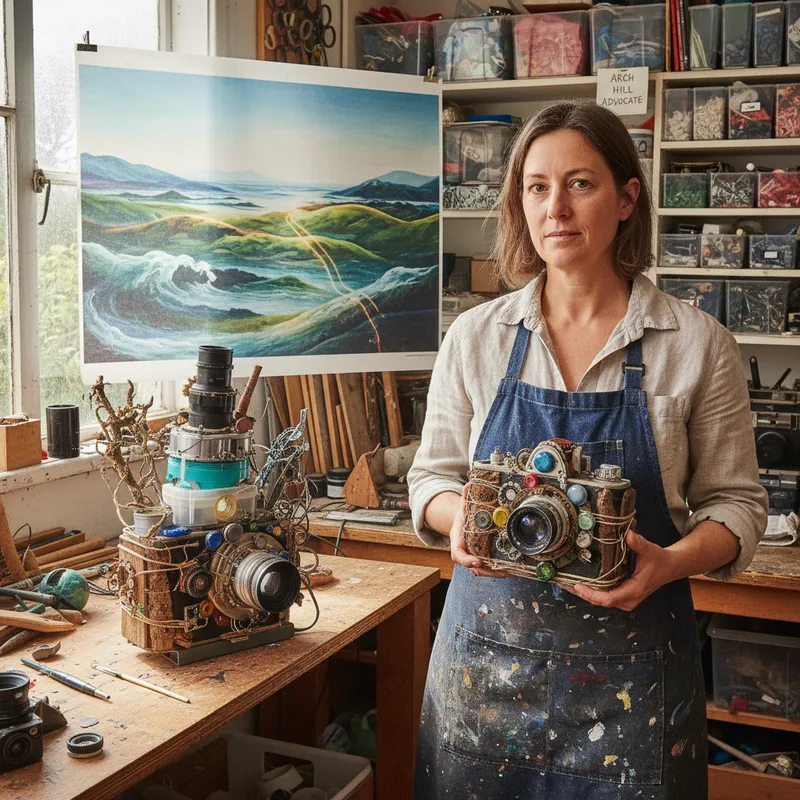
For Auckland artist Jenny Tomlin, a camera isn’t something you buy, but something you find. An old coffee container, a tomato sauce bottle, even a piece of wood riddled with borer holes can be transformed into a device that captures the world in strange and beautiful ways. Tomlin is a practitioner of pinhole and experimental photography, a field where humble objects become portals to a dream-like version of reality.
The initial appeal was simple. "Initially, it was about the delight of being able to make cameras out of anything at any size, from a matchbox to a wheelie bin and beyond," Tomlin says. This fascination perfectly aligned with her core inspirations: her relationship with the Aotearoa landscape and a desire to repurpose the objects society leaves behind. This approach allows her to explore alternative ways of seeing and to embrace the unexpected.
A pinhole awakening
Tomlin’s shift towards alternative techniques was sparked by a single, transformative experience in the late 1990s. She recalls seeing a global pinhole exhibition in a small gallery that opened her eyes to the medium's vast possibilities. The exhibition featured everything from a room-sized camera obscura to images taken from inside a mouth.
I’m enhancing the accidental, and deliberately breaking rules. I think the Lomography Community shares many similar aims.
The most memorable piece was a giant, multi-holed camera that was rolled down a hill. "Two-hundred and twenty films were wrapped around the inside, photographing the sun as dancing lines over and over as it rolled to the bottom. Wonderful!" she says. This event was a clear awakening, demonstrating that photography could be playful, subversive and profoundly unconventional. It set her on a path to creating her own accident-attracting cameras, resulting in images that feel more like memories or dreams than faithful representations.
Over time, her work has evolved from the simple wonder of a homemade camera working to a more abstract and experimental practice. She combines processes like solargraphy, where photographic paper is exposed for weeks, with lumen prints, which use the sun to create images with organic materials. In some projects, the environment itself becomes a co-creator of the final piece. "Or leaving cameras in the tidal zone, where the saltwater gets in and degrades the image," Tomlin explains. "The environment makes the image as well as being the image."
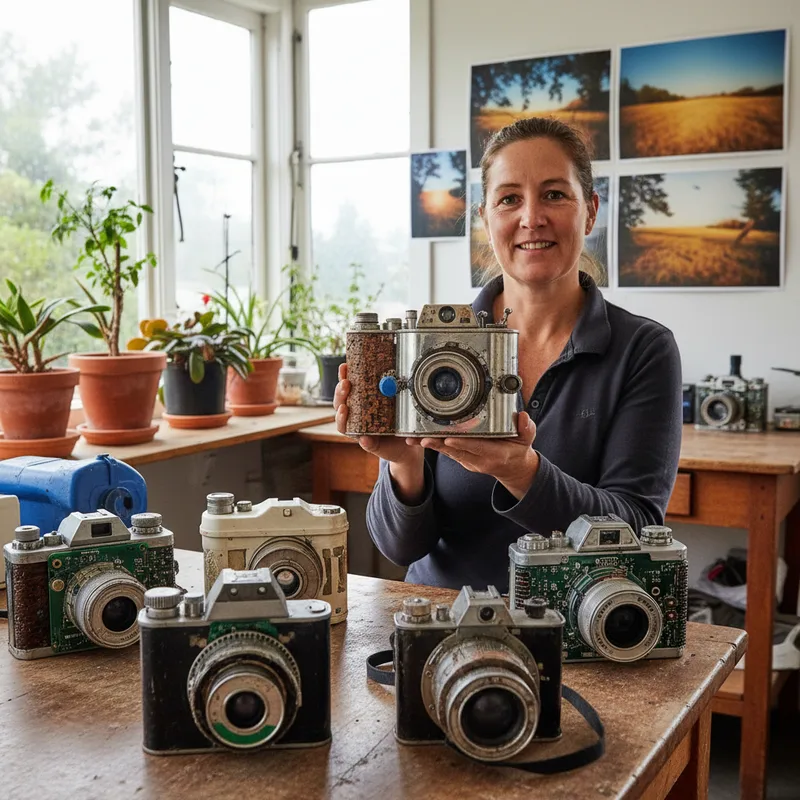
This practice of ceding control leads to a continuous dialogue between the artist, her cameras, and the natural world, a form of 'play practice' where the results are almost always a surprise. This focus on unique experiences echoes the spirit of exploring Auckland's diverse offerings, such as the fun things to do in Auckland this winter. You can also explore more of Auckland's local history through the city's newly opened digital archives.
From coffee tins to borer-riddled wood
When creating a new camera, Tomlin’s process is intuitive. She will see an object and immediately imagine its potential, valuing its unique qualities rather than trying to force it into a conventional shape. "I’m not interested in having something work in spite of its shape. I like a barely held-together aesthetic," she says. "There are lots of masking tape and temporary arrangements."
One of her most reliable and earliest cameras is one of her simplest: a plastic instant coffee container. For 25 years, its light-tight lid and perfectly curved shape, which holds a 4x5 sheet of film snugly without tape, have made it a favourite. It combines the qualities of a flat and curved pinhole camera, producing a slight wide-angle effect with leaning edges.
At the other end of the spectrum is her borer cam, made from a piece of wood infested with the insects. The large, numerous holes created by the borers act as pinholes. "The image would be very soft and overlap itself, so it shouldn’t work at all. But maybe it could?" Tomlin says. Used for a self-portrait series, the camera scattered her image, showing not a person but a presence. When she placed the photographic paper closer to the holes, each tiny image became distinct, creating what she calls a "bloom of possible worlds." The resulting work, 'All my Ghosts', suggests multiple versions of the self and endless possibilities.
Bringing art to the people
Beyond the darkroom, Tomlin is passionate about sharing her unique vision with the public. One of her proudest projects involved two solargraphy workshops that culminated in a public art installation on a bridge over a tidal river. The cameras were left to expose for five weeks, capturing the arcs of the sun and the movement of the water.
For those inspired to experiment with photography, Tomlin’s advice is to follow your passion. She encourages newcomers not to be disappointed by mistakes, but to look for the interesting and unexpected things they might reveal. "If you can find a like-minded community that you can share your work or thoughts with, that’s so valuable," she adds. The spirit of shared creativity is a lively part of the city's art scene, with events like the upcoming live speed painting battle on Dominion Road.
Tomlin is currently working on her next project, a small exhibition called Cross Track with another multimedia artist. For this, she is using an Eclipse Mints tin as a camera to photograph details in a local bush gully, aiming to immerse herself in the environment by going off the beaten path. The work will be presented as a series of vertical panels, continuing her exploration of how low-fi technology can produce fascinating and beautifully unpredictable results.